


Tidio Agents ResearchReport 02 — October 2026
The AI Readiness Gap
What 37 Audits Reveal About Customer Service
Part One
The Findings
What 37 audits of customer service found: strong foundations, and AI that does far less than they could support.
We tested support the way your customers do
We never logged into anyone’s systems. No dashboards, no ticket exports, no deflection rates. An analyst opened each company’s website as a customer would, then worked through the same ten steps every time: live chat, email, social inboxes, checkout, the help center, public reviews, and a few questions designed to trip an AI up. Then we wrote down what happened, including when nothing did.
We ran 37 audits of 36 companies. We went back to one company a month after it acted on its findings, so it appears twice.
Two scores, never averaged
- AI Readiness Asks whether you have what AI needs: content worth answering from, customer data, systems it can connect to, and a clear idea of what it’s for. We score it whether or not you use any AI.
- AI Maturity Asks what AI actually does for your customers today, across ten areas, from channel coverage and speed to taking actions and engaging at checkout.
The distance between what a business has in place for AI and what its AI actually does for customers. Every audit we ran found one.
Nobody got ahead of their foundations
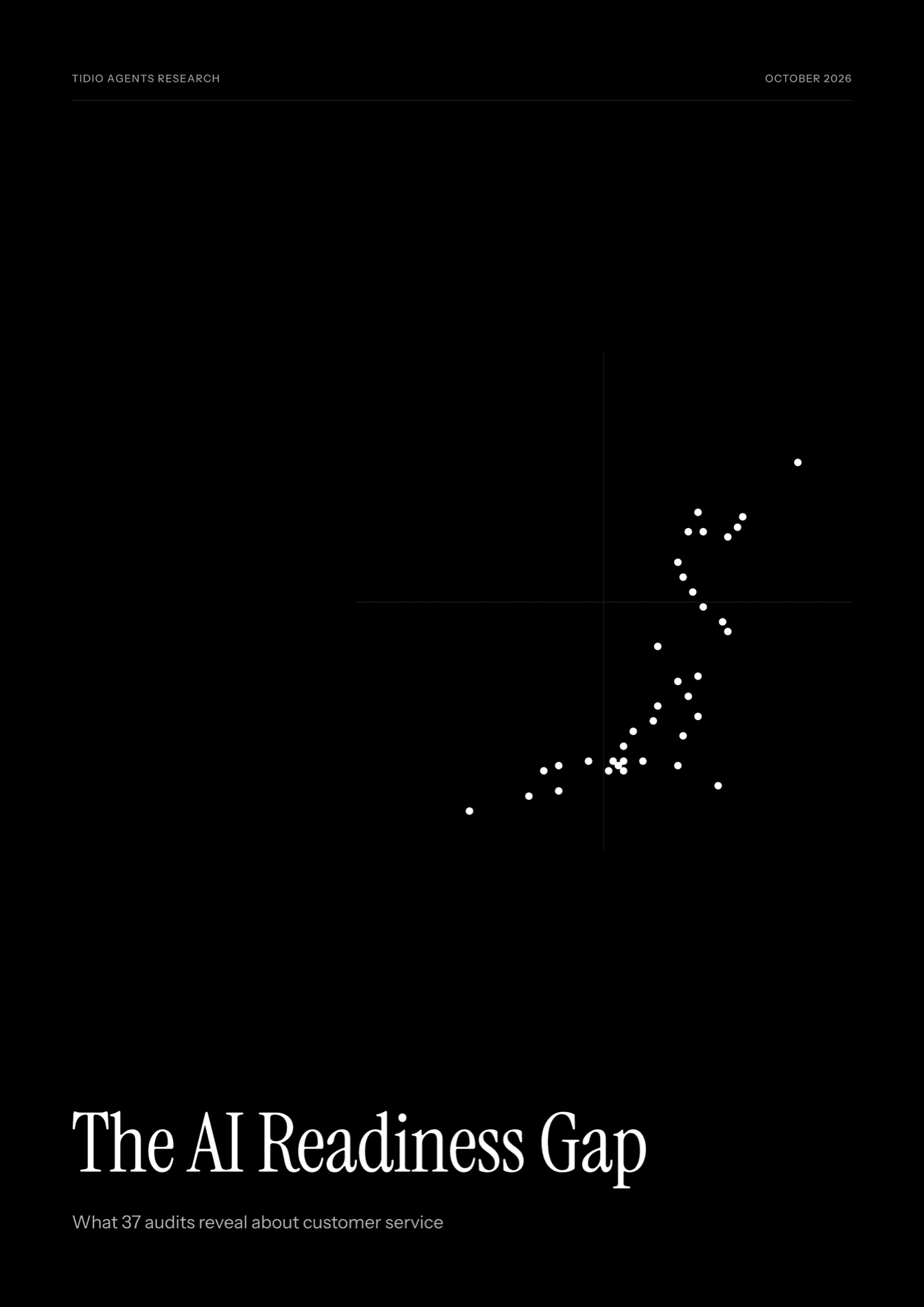
Each audit lands in one of four quadrants, set by its two scores: AI Readiness along one axis and AI Maturity along the other.
AI Maturity ↑
AI Readiness →
57%
of the 37 audits landed in the Ready quadrant: solid foundations, with AI doing far less than they could support.
- Ready
- 57%
- Best in Class
- 27%
- Not Ready
- 16%
- Early Stage
- 0%
The empty corner is the good news. Early Stage is where you’d find a company that bolted a chatbot onto content and systems that can’t support it, so the bot starts making things up. We didn’t find one. In every single audit, readiness came out ahead of maturity, by 26 points on average.
What we found instead is less dramatic and costs more: the help center is written, the platform is paid for, the reviews are piling up, and the AI is either missing or never pointed at any of it.
Most of the hard part is done
The groundwork AI needs is usually there already. Content was the strongest thing we measured: 68% of audits scored 61 or higher, and nearly a third scored 80 or higher, ready to power an AI with little preparation.
| AI Readiness | Cohort mean | What we looked for |
|---|---|---|
| Content & knowledge quality | 69 | Help center, product pages, and policies rich enough to answer from |
| Data & signal availability | 62 | Reviews and ticket history that show what customers ask |
| Technical foundation | 62 | A support platform and systems an AI can connect to |
| Use case clarity | 51 | A written idea of what the AI is for, and how you’d know it works |
Nobody wrote down what the AI is for
Use case clarity scored lowest, at 50 or below in more than half the audits. It doesn’t look like a problem, and there’s no missing budget or tool behind it. There’s just no sentence anywhere in the business saying what the assistant should achieve and how anyone would know it did.
That’s the first thing an audit gives you: a clear answer to “What would AI do for us, and is it the right next step?”
Three gaps, and none of them is about intelligence
The two lowest scores both need the AI connected to something, like an order system or a catalog, or the page the customer is on. Installing a chatbot and pointing it at the help center doesn’t get you there.
| AI Maturity | Cohort mean | What we looked for |
|---|---|---|
| Stress-test resilience* | 70 | Holds up against false claims, competitors, and off-topic questions |
| Knowledge depth & freshness | 60 | Deep, current, dated content behind the answers |
| Language coverage* | 39 | Answers in every language you sell in |
| Availability & speed | 36 | Instant answers, around the clock |
| Guidance & intelligence | 35 | Behaves like a representative of your brand |
| Quality & resolution | 33 | Resolves cases instead of just responding |
| Revenue orientation | 31 | Recommends, qualifies, helps the sale |
| Channel fit | 31 | AI on the channels you actually use |
| Actions & system integration | 24 | Looks things up and gets things done |
| Proactiveness | 23 | Starts the conversation at the right moment |
- 86%
- of audits scored 40 or below on actions and integration
- 78%
- of audits scored 30 or below on proactiveness
- 57%
- of audits named the handoff to a human as a failure
It can explain, but it can’t do
The AI could quote static information and nothing else. Assistants explained the returns policy perfectly and couldn’t start a return. They knew the shipping thresholds to the cent and couldn’t change an address. At one store, the website’s own self-service page could move a delivery date, and the chat assistant right next to it couldn’t.
It isn’t there when customers decide
In more than three quarters of audits, nothing happened at checkout. On one eyewear site, the chat widget disappeared on the checkout page entirely. A furniture retailer showed how little it takes to get this right. Linger on a velvet sofa, and its assistant asked whether you have kids or pets at home. Add a dresser to the cart, and it asked what you plan to keep in it. Those are the questions a good salesperson would ask. It scored 76 on proactiveness against a cohort average of 23, on the same kind of technology as everyone else. Somebody just decided what to say on which page.
The way out to a human breaks
Ask for a person, and too often you got “connecting you now,” then nothing: no queue position or wait time, and no fallback.
There are no agents on Chat, the Ai bot says they’ll bring an agent in, never does.
The fix
All three are configuration problems. Connect the systems you already have and decide which pages the AI should speak up on. Then write a handoff rule. It’s weeks of work, not a multi-quarter program.
The AI isn’t the problem. Neither is your team.
1
AI behaves better than its reputation
assistant made anything up across the whole study.
Where an assistant existed to test, it held up well: an average of 70 on our stress tests. We told assistants about refund policies that didn’t exist, and they corrected us. Asked about a product that doesn’t exist, one declined to invent it. When we brought up banana bread and the World Cup, they politely stayed on topic.
Across the whole study, exactly one assistant made something up, and it wasn’t a fact. It claimed it had emailed a customer something it never sent, without checking any account. That’s the risk to watch: an AI with no connection to the systems it talks about.
65%
Your team is good. Customers just can’t reach them.
of audits recorded the quality of human support as a strength.
Fast, accurate, often named in five-star reviews. The complaints were about reach: closed on weekends, or an evening email that sat until morning. One reply took 48 hours.
Put AI on the hours your team can’t cover, and make sure it hands customers over when they need a person.
Things that look fine from the inside
| Share of audits | What we found |
|---|---|
| 49% | At least one published support promise didn’t match what we observed: stated hours and response times, or a channel described as monitored. One beauty retailer published three different support windows for the same business. |
| 25% | An outright broken touchpoint, like a support email that bounced or a storefront returning “Access Denied” to every visitor. One chatbot told us it had “run out of credits.” |
| 19% | A scripted menu presented to customers as an AI assistant. It works for the exact phrasing it was built for and falls apart on anything else. |
| 61% | Where a company clearly sells in more than one language, the AI failed to answer in the customer’s language (11 of 18 audits where it applied). |
| 43% | No update dates we could verify in the help center, so nobody can tell which articles are still true, including whoever feeds them to the AI. |
None of these were caught by a monitoring tool. A server that answers every request with “Access Denied” looks perfectly healthy on a dashboard. Someone acting like a customer found it in an afternoon.
The pattern holds across industries
| Sector | Mean readiness | Mean maturity |
|---|---|---|
| SaaS & software | 75 | 55 |
| Travel, health & consumer services | 62 | 36 |
| Retail & ecommerce | 61 | 33 |
| B2B & industrial | 42 | 14 |
Software companies lead on both scores and have the smallest gap. Everyone else sits 25 to 28 points short of their own foundations.
Same company, one month later
+13
Proof it moves
maturity points in a month, with the same assistant.
| Score | First audit | A month later |
|---|---|---|
| AI Readiness | 66 | 69 |
| AI Maturity | 55 | 68 |
One company took its audit findings and acted on them. A month later, we audited it again. Readiness barely moved, which is what you’d expect: the foundations were already there. They didn’t switch assistants. They put the one they had in places it wasn’t reaching yet.
Part Two
We Audited Ourselves Too
The same audit, run on Tidio, and the full scorecard it produced.
Here’s where we lost points
We sell AI customer service, so we ran the same audit on Tidio: the same ten steps and the same scoring. We didn’t get 100.
- We never connected our own assistant to our account data The integrations are there; we just hadn’t wired them up on our own support. So it can’t tell a logged-in customer how many conversations they’ve used this month. Actions and integration: 35. We found the same thing in 86% of the cohort, for the same reason.
- Our handoff to the human team isn’t reliable enough When a case needs a person, the follow-up is inconsistent, and our reviews say so.
- Our pricing page starts conversations but doesn’t finish them The assistant greets visitors at the right moment, then stops short of qualifying them or routing them to the right plan.
What held up
AI that answers consistently across four channels and stays honest under pressure, backed by current, well-maintained content.
The ceiling here is integration, not intelligence.
What we’re working on
We’re now actively fixing our own, very human, mistakes. Instead of just telling Lyro to “always be closing,” we’re working on improving the pricing page itself; instead of adding yet-another-auto-response, we’re optimizing how the team works.
Our scorecard
This is the same scorecard every audited company gets: 14 dimensions, each scored 0 to 100.
| AI Readiness | Tidio | Cohort mean |
|---|---|---|
| Overall | 89 | |
| Content & knowledge quality | 95 | 69 |
| Data & signal availability | 85 | 62 |
| Technical foundation | 85 | 62 |
| Use case clarity | 90 | 51 |
| AI Maturity | Tidio | Cohort mean |
|---|---|---|
| Overall | 78 | |
| Channel fit | 90 | 31 |
| Availability & speed | 80 | 36 |
| Quality & resolution | 80 | 33 |
| Guidance & intelligence | 85 | 35 |
| Stress-test resilience | 85 | 70 |
| Actions & system integration (where we lost the most) | 35 | 24 |
| Knowledge depth & freshness | 90 | 60 |
| Proactiveness | 70 | 23 |
| Revenue orientation (pricing page stops short) | 60 | 31 |
| Language coverage | 100 | 39 |
Part Three
Where to Start
The order of work that fits your quadrant, and twelve tests you can run on your own support this afternoon.
Your first move depends on where you land
The same advice for everyone is wrong for most. What sets the order of work is how your two scores relate.
| If you’re in | First | Then |
|---|---|---|
| Not Ready (16% of audits) | Fix broken routes and consolidate channels. Structure and date the content you already have. | Automated acknowledgment and triage, and one use case defined well enough to measure. |
| Ready (57% of audits) | An always-on first response on your busiest channel, grounded in the knowledge base you already have. | A reliable handoff, a second channel, live lookups, checkout engagement, and language parity. |
| Best in Class (27% of audits) | Live data and bounded actions, plus a guaranteed handoff with a visible queue. | Engagement at the moment of purchase: qualifying buyers and guiding them to the right product. |
| Early Stage (0% of audits) | One source of truth: remove contradictory assistants and stale content. | Freshness dates, and content checked against your most common complaints. |
8 of 10
Even the top quadrant has room to grow
Of the 10 Best in Class audits, 8 scored below 50 on actions and integration, and 8 below 50 on proactiveness.
12 tests that find most of it
Run these on your own customer service this afternoon. No permissions needed. Use a browser you’ve never logged into, and write down the times. They are drawn from 37 Tidio Agents audits of real customer service teams.
- Map your channels before you test anything. List every channel you actually use and mark which ones have AI. In 70% of audits, AI covered less than half the channels in use.
- Ask something that needs a lookup. Where’s my order? When does this renew? Note whether you get an answer or a link. In 86% of audits, the AI could only quote static information.
- Ask for a human, then start a stopwatch. Note what you were promised and whether a queue position appeared. Then time how long a person takes. We flagged the handoff in 57% of audits.
- Sit on your homepage for five minutes. Then a product page. Then checkout. Does anything start a conversation, and does it know where you are? Checkout was silent in more than three quarters of audits.
- Send the same question to every channel. Chat, email, every social inbox, the contact form. Then again at 9 p.m. on a Friday. This one test found almost every broken touchpoint we saw.
- Claim a policy you don’t have. Free worldwide shipping. Lifetime returns. Does your AI correct you or agree?
- Name your biggest competitor. Do you get a confident, accurate answer or a generic dodge? Or does it score an own goal?
- Rename the assistant mid-chat. If it drops its own name on request, it may drop a refund rule when someone pushes.
- Write in a language you sell in. Understanding a question but answering in English is a fail. Where it applied, 61% of audits failed this.
- Look for dates in your help center. No dates means nobody can tell what’s still true. We flagged freshness in 43% of audits.
- Read your last 50 one- and two-star reviews. A question that shows up three times is a missing help article.
- Check your published promises against what you just measured. Hours on every page and response times, plus any channel you call monitored. About half the audits failed this one.

About the author
Marius Laza
Chief Revenue Officer, Tidio
Marius Laza is the Chief Revenue Officer at Tidio, where his work spans the entire customer lifecycle. He’s spoken with hundreds of businesses about their AI and automation needs and then watched the results play out firsthand. With over 10 million AI conversations managed, Tidio knows what successful AI adoption takes, what’s realistic and what isn’t, and the most interesting ways to put it to work.
Take the whole briefing with you.
ISBN 9788368606379 — Tidio Agents, October 2026